Do air purifiers really remove cigarette smoke?
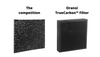
Yes, when the purifier has enough activated carbon for the room and the smoke load. Activated carbon captures the gases and odor compounds in cigarette smoke; HEPA filtration captures the visible particles. The TrueCarbon series carries over 3 lbs of granular activated carbon — about 6× what most budget purifiers include — which is what allows it to handle ongoing cigarette smoke without saturating in days.
What's better for smoke: HEPA or activated carbon?
It depends on whether the concern is particles or odor. HEPA captures the visible smoke particles that aggravate respiratory symptoms. Activated carbon captures the gases and odor molecules that make smoke linger after the source is gone. Most households dealing with regular indoor smoke want both — which is what the Mod Jr. and Mod+ provide in one filter. If odor is the primary concern, a carbon-only purifier like the TrueCarbon series may be sufficient.
How much carbon does an air purifier need to handle smoke?
For ongoing indoor smoke (regular cigarette, cigar, or marijuana use), a minimum of 2 lbs of granular activated carbon is the practical threshold. Below that, the filter saturates within weeks under heavy use and odor performance drops sharply. The TrueCarbon series carries over 3 lbs per filter for this reason.
Does an air purifier remove the smell of smoke from clothes and furniture?
An air purifier removes airborne smoke smell and prevents new smoke from settling into fabrics. It doesn't actively remove smell that's already embedded in fabric, carpet, drywall, or upholstery. For best results, run the purifier continuously, wash fabrics that can be laundered, and consider professional cleaning for carpet and upholstery if the smoke load was heavy.
Can an air purifier handle smoke from a neighboring apartment?
Yes, with the right unit and proper sizing. Smoke that enters from a neighboring unit typically arrives through shared walls, HVAC, or under doors — meaning it's already aerosolized when it reaches your space. A properly sized carbon air purifier running continuously in the affected room can substantially reduce both the smell and the particle load. The TrueCarbon 200C is a common choice for this situation in a typical apartment living room.
How long does the carbon filter last?
Filter life depends on smoke load. Under typical household conditions (occasional cooking smoke, light VOC sources), TrueCarbon filters last approximately 12 months. Under heavy indoor smoking conditions, expect 6–9 months. The purifier's filter indicator will tell you when to check it; you can also gauge filter life by smell performance — when odors start lingering longer than they used to, it's time to replace.
Are Oransi air purifiers safe? Do they produce ozone?
All Oransi air purifiers are certified ozone-safe by the California Air Resources Board (CARB). They do not use ionization, ozone generation, or any other active air-modification technology. The TrueCarbon series uses only mechanical filtration: a pre-filter, then granular activated carbon. The Mod Jr. and Mod+ add HEPA media to that. No ionizer, no ozone, no UV.